Crossing the Divide - UNION Deep Tech Commercialization Bootcamp
A comprehensive report from the UNION Deep Tech Commercialization Bootcamp.
Feb 04 2026
On February 4th, a curated group of founders, VCs, and corporate leaders gathered at the SVB Experience Center in San Francisco for "Crossing the Divide," a tactical bootcamp focused on the gritty realities of commercializing deep tech. The message from the host was clear from the outset: we are in the "steroid era of venture capital," and the old playbook is dead. The new expectation for high-growth startups isn't the familiar "triple, triple, double, double," but a blistering 1 to 15 to 100 trajectory.
This recap captures the key frameworks, war stories, and actionable advice from a day packed with insights from operators who have built, sold, and funded companies at the highest level. For those who couldn't make it, here is your blow-by-blow report.
Note: This recap follows Chatham House Rules. Participants and their affiliations are listed below, but specific quotes are not attributed (with the exception of the VSC marketing session, which was a formal presentation).
Participants
The event featured insights from an impressive lineup of operators, investors, and advisors, including:
- Nate — Union Peak (Host)
- Alex Miller — Co-founder, Hippocratic AI
- Walter Aldana — VP Partnerships, Grok (formerly Snowflake)
- Vijay Chattha — Founder & CEO, VSC
- Larry Chu — Co-Head of M&A, Goodwin
- Amit — Schneider Electric Ventures (formerly Cisco M&A)
- Barat — CEO, Intangible AI
- Vinay — Co-founder, Mill (acquired by Amazon)
- Damon — Founder, RunDeck (acquired by PagerDuty)
Session 1: 0 to 1 "Ground & Pound" GTM Tactics
The day kicked off by demolishing a common founder misconception: founder-led sales does not mean founder-only sales. While a founder's presence is critical in early customer meetings, they shouldn't be alone. Bringing in a "pathfinder"—a scrappy, full-stack seller, not a polished CRO—can double the number of customer touches, accelerating the path to product-market fit.
One speaker shared hard-won lessons from building an AI company that recently raised at a multi-billion dollar valuation:
"Always charge for your product. We have never gotten good feedback from the folks that we don't charge... Money is the only valid form of feedback."
The explanation was clear: free pilots lead to building the wrong, low-ROI use cases. The moment a customer has to write a check, the feedback becomes real. Other key takeaways included:
- Sell to the C-Suite: Deals sold to the C-suite had dramatically higher Net Revenue Retention (NRR) than those sold to VPs or lower. The top executives are the ones who can reimagine workflows and sponsor true transformation.
- Avoid Innovation Teams: Selling to innovation departments often leads to poor adoption. The operations team, who will ultimately own the integration, is the real champion you need to win over.
- Find the "No" Early: Every deal has a lurking "no." Proactively identify the top four or five objections (e.g., "Will I lose my job?", "Is AI going to kill somebody?") and build answers directly into your pitch deck to preempt them.
Session 2: The Perfect Partnership Strategy
An operator with a stunning track record at major data companies made a powerful case for building an ecosystem from day one, citing a study that companies who do so see a 5x revenue multiplier.
The session was a masterclass in playing the long game, exemplified by a now-famous "frenemy" relationship between a data company and a major cloud provider. While the CEO was publicly declaring war on the cloud provider's competing product, the partnerships team was building a relationship behind the scenes. The move was controversial, with the sales team thinking the partnerships lead had "gone mad" for inviting a cloud executive to their sales kickoff. But the result was millions in marketing development funds and the cloud provider becoming a critical channel.
"The more competitive the company likely is... there's actually another side of that coin, which is they actually want to have a good brand. They want to be a good partner."
The tactical advice was direct:
- Identify Your "North Star" Partners: Figure out the one or two key partners that can unlock the market and get on their radar immediately.
- Don't Go It Alone: Build friends early and often. Your partners become your evangelists, providing free marketing and buzz that you could never create on your own.
- Put the Customer First: When you focus on solving a customer's problem, all the friction—the bad-mouthing, the internal politics, the channel conflict—goes away.
Session 3: Marketing & PR That Actually Drives Sales (A VSC Deep Dive)
Speaker: Vijay Chattha (Founder & CEO, VSC)
Vijay Chattha opened his session by polling the room on where they get their news. The answers—LinkedIn, Ars Technica, X, and "friends"—illustrated his core thesis: the media landscape is hopelessly fragmented. This fragmentation is both a challenge and an opportunity for founders.
Vijay's credentials are formidable: VSC has worked with over 1,000 startups, helped build $100B in value across 60+ exits, 50+ unicorns, and 3 IPOs, and has been profitable for 24 years. His advice was hard-won and tactical.
"If you want to be successful, you have to be cringe as fuck. You have to be ready to be annoying and lame, but salesy to the point where the people on the other side remember you. This is not a cool game. We're here to work."
Why Marketing Matters More Than Ever
Vijay argued that for most B2B and deep tech startups, the target audience is a surprisingly small group of less than 10,000 people. The goal isn't to be famous to the world; it's to be famous to the people who matter. He urged founders to become their own media companies.
A key insight was that AI is reviving the value of PR. Why? Because LLMs like ChatGPT are trained on quality media. If you want to show up when a potential customer asks an AI for recommendations in your space, you need to be in the publications and podcasts that the AI is learning from. This is a fundamental shift in the value proposition of earned media.
The Core Framework: The Escalator Pitch
Can you describe your company in three to four words? This is the "escalator pitch"—the story you can tell as you pass someone going the opposite direction on an escalator. It forces a level of clarity that is essential for every other marketing activity.
"This three-words thing we were talking about earlier, very important that everybody in your company could describe you, but more importantly, that your customer can describe you to somebody else. They're your PR people. Your customers are your PR people."
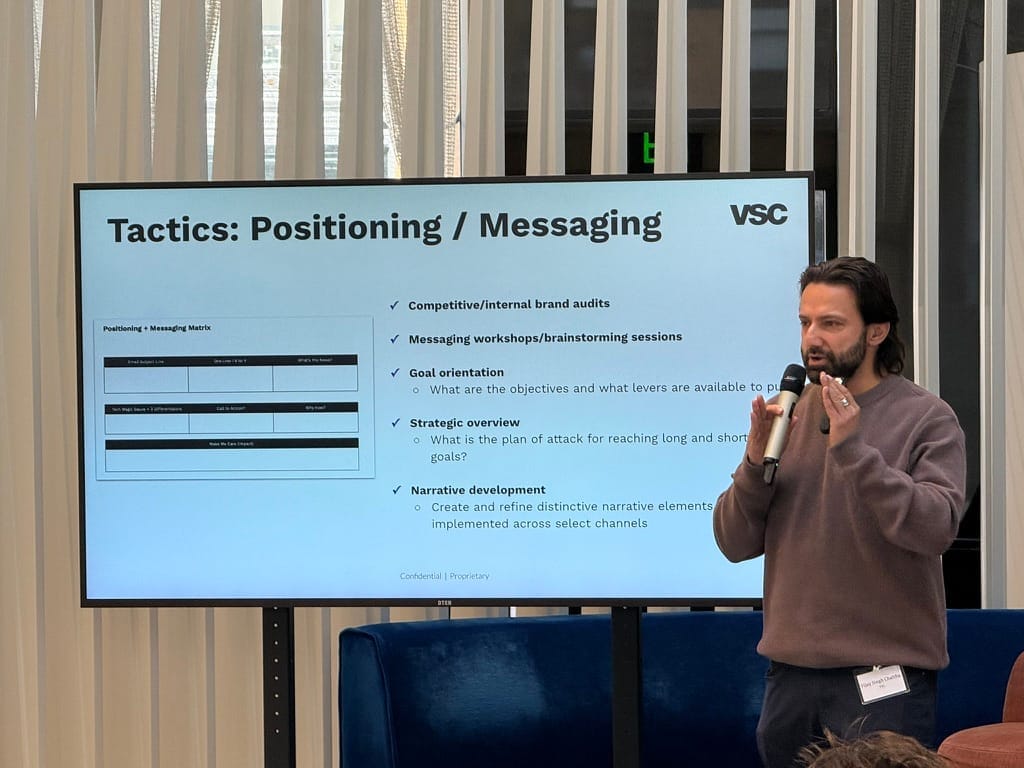
The VSC Positioning & Messaging Framework
Vijay walked through the structured process VSC uses with clients:
| Element | Key Question |
|---|---|
| Email Subject Line | What's the hook that gets a journalist to open your email out of 300 pitches? |
| Three-Word Description | Can everyone in your company describe you the same way? |
| News Hooks | What are your launch moments? (Product launches, funding rounds—maximize them.) |
| Tech Magic Sauce | What are 3 differentiators that no one else has? |
| Call to Action | What do you want people to do after they read about you? (Hire, buy, invest?) |
| Why Now? | Why does your innovation matter to the rest of the world right now? |
The Modern Media Playbook: Tactical Advice
1. Create Your Own Media Company
Identify your 10,000-person audience. Get their LinkedIns. Build your own list. This is your private TechCrunch. You should know every potential customer you want to reach, and you should ask them: How do you get influenced? How do you find out about companies like ours?
2. Do PR for Your PR
Don't just hope people see your press. Vijay's team creates a custom audience on LinkedIn of exactly the target audience. Every time a piece of press comes out or a post does well, they run an ad boosting that content directly to the custom audience.
"The best part of it is like you make all this stuff, you don't know if anyone sees it. There could be breaking news right now. Nobody's reading it. We're all here. You have to push it to people. We call it 'do PR for your PR.'"
The added benefit: you can see which companies are clicking. If a target company clicks 100 times, maybe you should talk to them.
3. Video is the Future of B2B Storytelling
Short-form video currently performs about 6x better than text for VSC's clients. Why? Text is so easy to generate with AI now that very few people read it unless it's from someone they really care about. Video catches the eye, and platforms like LinkedIn, Instagram, TikTok, and YouTube Shorts are all prioritizing it.
Vijay's team shoots one-hour video interviews with founders, asking 10-20 questions, then cuts them into snappy clips for LinkedIn. The BD and sales teams can use these clips as well.
A key insight: enterprise customers trust a founder's personal social media more than corporate PR because it's authentic and consistent. The future of social media thought leadership is individuals on platforms, not corporations.
"People are buying from people in B2B right now. They used to buy from a brand only. Now they're buying from a brand plus a personality. And that personality is the expert in that thing."
4. Podcasting as a Sales Strategy
This was a major focus. Vijay's advice was to make your own podcast. Here's the playbook:
- Invite 50 potential customers to be guests.
- You spend one hour bonding with them, going deeper than you ever have before.
- You make them look good by sharing clips on their LinkedIn.
- All their followers—who are probably other potential customers—see your brand.
- You get deep market intelligence.
- You will close deals. It's conversational marketing.
"If you can't get to 50 episodes, don't do it. 95% of podcasts have never got past 50 episodes. If you did it, you'd be like a unicorn of podcasting."
If you don't have 50 customers, hack it: get your investors, advisors, and partners like SVB to come on. The clips become marketing content for you. It's what webinars used to be, but better.
To find if there's enough "shelf space" for a podcast in your niche, use tools like Spotify or ListenNotes to search for podcasts in your vertical. If there are only 10-15 podcasts in your space, that's a green light.
5. AI is Your Secret Weapon
Vijay shared a brilliant hack for coaching technical founders on their messaging:
"I used to say, 'Hey, I am the non-technical person and I cannot understand anything you are saying.' Now I take what they write, put it in GPT, and say 'play the role of a journalist and rate this a one out of ten.' It comes back as a two out of ten, and I'm like, 'See, AI thinks you suck at this.' And they're like, 'Okay, okay, I understand.'"
AI is also useful for generating content ideas, rewriting jargon into plain English, and getting an objective outside perspective on your messaging.
The Thought Leadership Question
A founder asked: Should a CEO be known for one or two deep topics, or be a polymath? Vijay's answer was nuanced:
- Yes, be known for one thing. You want to show up when someone asks ChatGPT about your niche.
- But also be the customer. What are they thinking about today that you might know something about? Post about that.
- Have a contrarian opinion. What do you believe that most people in your industry disagree with? Talk about that.
Goal Setting for Marketing
Vijay stressed the importance of simple, clear goals:
"Sometimes the goal is just like, 'I want more sales. I need five more logos. I need to hire the best engineers.' Give your agency or in-house team simple goals. Not 'we need to be the most famous' or 'OpenAI did this, we should do it.' Just: 'In the next six months, if we can achieve this, that's success.'"
He shared an example of a founder who said, "We want to launch because we're trying to close our next round of funding. Help us blow this shit up so we can get some funding in the door." Vijay's response: "God bless it. Such a simple, clear goal."
Final Takeaway: Problem vs. Solution Messaging
A question from the audience asked about how much time to spend on the problem versus the solution. Vijay's answer: it depends on where the market is.
"I think you spend a lot of time on the problem until it's a universal fact that everyone knows the problem... We have an AI services company and they asked, 'How much should we talk about how businesses want to use AI?' I said zero. Everybody's already heard that. Now just assume they're all looking at 10 solutions. Why are you different?"
Vijay's session was a powerful reminder that in a world of infinite content, authenticity, consistency, and a willingness to be a little "cringe" are the keys to breaking through.
Session 4: M&A Basics for Founders
The M&A session delivered a sobering and essential perspective on the realities of acquisitions. The core message: M&A is a trust game. It's not a financial transaction; it's a strategic one. The best companies are bought, not sold, which means you need to be building relationships and educating the market on your value long before any offer materializes.
The Three Components of Startup Value
The three core components of value in any startup were outlined:
- The People: Especially in deep tech, the collective know-how of a team that has worked together for years is immensely valuable. This is why acquirers often want founders to stay on.
- The Technology Moat: True differentiation in your architecture or a problem you've solved in a unique way.
- The Business Model: The strategic value of your partnerships, go-to-market, and the flywheel you've already started spinning.
The "Ball Control" Framework
A critical piece of tactical advice was to take back ball control from corporate development teams. Once you get handed off from the decision-makers (the CEO, the BU leader) to the corp dev team, you are in a robotic, process-driven phase where "no" is the default answer. The key is to spend as much time as possible with the strategic leaders, co-creating the story of why the acquisition makes sense.
"The best thing to do is think about along the way, who are the top five companies that could buy you, that would buy you, and become their best partners."
A powerful analogy was shared: corp dev teams are like cops on a reality TV show—they're not out canvassing for cold leads; they're sitting around waiting for someone to call them with a tip. You need to be on their radar.
Lessons from Real Acquisitions
One speaker shared the story of selling a consumer hardware company for over $100 million. The key lessons:
- Start relationships early: Years before the M&A, the company was having conversations with potential acquirers, even proposing joint products.
- M&A deals often fail: The first process with a major tech company didn't close. Be prepared for that.
- Protect your runway: When negotiating, ensure you have enough cash to walk away. One tactic: negotiate a clause that if the deal falls through, the buyer has to give you additional runway.
- Binding LOIs matter: Unlike VC term sheets, M&A letters of intent should be binding. Buyers will try to renegotiate if they know you're running out of cash.
Corporate Venture Capital: Friend or Foe?
The panel had a nuanced discussion on CVCs. Key points:
- Not all CVCs are the same. Ask: Are you a balance sheet fund? Do you have outside LPs? Do you only invest in things strategically relevant to your business?
- Avoid giving away strategic optionality. A "right of first refusal" on acquisition is like telling every other potential buyer that you're engaged. Don't do it.
- Separate the investment from the commercial deal. If they want to invest, invest. If they want a commercial deal, structure it separately with its own incentives (like warrants).
- Small minority investments are fine. If a corporate has a small minority stake, the benefits outweigh the risks. But if they have 35-40%, that's a market signal that an acquisition is coming.
M&A Offers and Conviction
Advice on handling early-stage M&A offers:
"Buyers are always going to say, 'Hey, this might be an opportunity to grab this team, this technology on the cheap.' They're not necessarily competing against other offers. They're actually testing how much conviction you have around building a big company."
If you want to achieve a strategic premium at an early stage, you have to show a huge amount of conviction. Being prepared is one way to seem confident. Being clear about your product, go-to-market, and team is another.
The Market Context: PE and M&A Trends
Valuable market context was provided:
- 2024 was the second-largest M&A year in history: $5.1 trillion in M&A (2021 was $5.9 trillion).
- Tech is 19% of global M&A and growing.
- PE has $1.7 trillion in dry powder and needs to deploy it. Roll-up strategies will become more common.
- The fundraising market changes constantly. The Q1 2026 market is very different from Q2 2025. This is why having advisors who do this every day is so valuable.
Session 5: What Corporates Will Actually Pay For
The final session provided a rare look inside the mind of a corporate acquirer, drawing on experience from hundreds of acquisitions at major tech companies.
The Corporate M&A Machine
One major tech company has done 300+ acquisitions—roughly one every 2.4 months. The culture was described vividly: the CEO would literally "swoop in, pick up somebody from the floor, and tell them to go buy companies. It was like grocery shopping."
Three Types of Acquisitions
| Type | Revenue | Valuation Method | Key Considerations |
|---|---|---|---|
| Tech & Talent | No/small revenue | $/headcount basis ($4-5M per AI head in 2015) | Fast process, VP-level sponsorship, fast integration |
| In-Betweeners | $10-50M | Triangulated valuation (DCF + comps) | Can corp sales teams sell this? Limited synergies expected. |
| Big M&A | >$50M | Platform buy, goes to Board | Preserve team and culture. Thoughtful integration over time. |
For platform buys, the lesson learned was to leave the culture alone. Don't disband teams or integrate them into different parts of the organization. The cultural glue is what made those companies valuable in the first place.
The Budget Cycle Reality
One of the most critical, and often overlooked, pieces of advice was to get designed into the corporate budget cycle. If you're not in the plan for next year, the resources (headcount, marketing dollars) will not be there to make a partnership successful.
"To get a startup to work with a corporate, you have to be designed into their budget cycle. Budgets are tight. If you're not designed into the budget cycle for next year, they will not spend the resources—AKA headcount—to align with you, to launch your product, to demo test it out, to integrate it."
Three Types of Partnerships
The partnership landscape was broken down:
- Referral Agreement: Simplest form. Share logos, co-market. A fast way to get a corporate logo on your website.
- Reseller Agreement: The corporate sells your product. More complex, involves revenue share.
- Hero Offers (OEM): The holy grail. Your product is embedded inside a larger corporate offering. Marketing dollars are spent to promote it.
A warning on software partnerships: software stacking is a real issue. If a hardware company is selling your software, they're selling at lower-than-hardware gross margins. This can be a roadblock.
Reflections on M&A from the Corporate Side
Hard-won lessons from the corporate perspective:
- Build partnerships and business relationships early.
- Be prepared to commit to longer-term targets (i.e., longer-term incentive alignment).
- Software sales talent is hardest to retain post-acquisition. Every PE firm starts calling your CRO the moment the deal is announced.
- Help the corp look for extra synergies beyond base case. This unlocks additional value (i.e., purchase price).
- Manage your board towards realistic outcomes. Many transactions fall apart because of a mismatch between the CEO, corp dev, and the board on what the asset is worth.
- Be humble.
The Gotchas & Warnings
Throughout the day, speakers shared cautionary tales and common mistakes to avoid:
- Don't hire a CRO too early. Your first sales hire should be a "pathfinder"—a scrappy, full-stack seller who can do everything. A CRO is for when you have a repeatable playbook to scale.
- Don't give away strategic optionality to CVCs. A "right of first refusal" on acquisition is a death knell. It tells every other potential buyer that you're already engaged.
- Don't let one customer become >50% of revenue. This creates dangerous concentration risk and weakens your negotiating position.
- Don't sell to innovation teams. They often can't drive adoption. Sell to the operations team who will own the integration.
- Don't impose Silicon Valley business models on traditional industries. Understand how your customers actually buy and structure deals accordingly.
- Don't bad-mouth partners. Your reputation is portable across companies. If you say you're going to partner with one company, you can't turn around and tell someone else you're not. Word gets around.
- Don't underestimate the distraction of M&A. If you're at the messy stage without product-market fit, getting sucked into an M&A process can be fatal.
Memorable Moments & Quotes
The day was full of memorable lines and stories. Here are some highlights (unattributed per Chatham House Rules, except for VSC):
- "This is the steroid era of venture capital. This is Mark McGuire and Jose Canseco." — on the current fundraising environment.
- "Be cringe as fuck." — Vijay Chattha, on what it takes to break through the noise.
- "Money is the only valid form of feedback." — on why you should always charge for pilots.
- "People are buying from people in B2B right now." — Vijay Chattha, on the shift from brand-only to brand-plus-personality.
- "Corp dev teams are like cops on a reality TV show—they're sitting around waiting for someone to call them with a tip." — on why you need to be on the radar of potential acquirers.
- The AWS Sales Kickoff Story: While a company's CEO was publicly at war with AWS, the partnerships team invited an AWS executive to their sales kickoff. Everyone thought they were crazy. It resulted in millions in marketing development funds.
- The $1.5B Deal: One speaker helped close a $1.5 billion deal—a reminder that partnerships can be transformative.
- The $100M+ Acquisition: A company was acquired for over $100 million after years of building relationships with potential acquirers, even when they "didn't like us" and "thought we were hipsters from San Francisco."
Cross-Cutting Themes & Final Thoughts
Across all five sessions, a few powerful themes emerged:
- Relationships are the Ultimate Moat: Whether it's with partners, customers, or potential acquirers, the human element and trust are the foundation of every successful outcome. This is a human business.
- Start Early: The time to build your partnership ecosystem, your M&A narrative, and your marketing engine is now, not when you need it.
- Be the Expert: In a noisy world, deep expertise, communicated clearly and consistently, is the ultimate currency.
- The Bar is Higher: The new expectation is 1→15→100. Triple, triple, double, double is dead. But for founders who are willing to be strategic, relentless, and a little bit cringe, the opportunity is immense.
The "Crossing the Divide" event was a powerful dose of reality and a playbook for navigating the treacherous, but potentially rewarding, landscape of deep tech commercialization. Part two is coming later this year.
Written by Bogdan Cristei and Manus AI