R2R vs. P2P: Two Manufacturing Regimes, One Intelligence Opportunity
Executive Summary
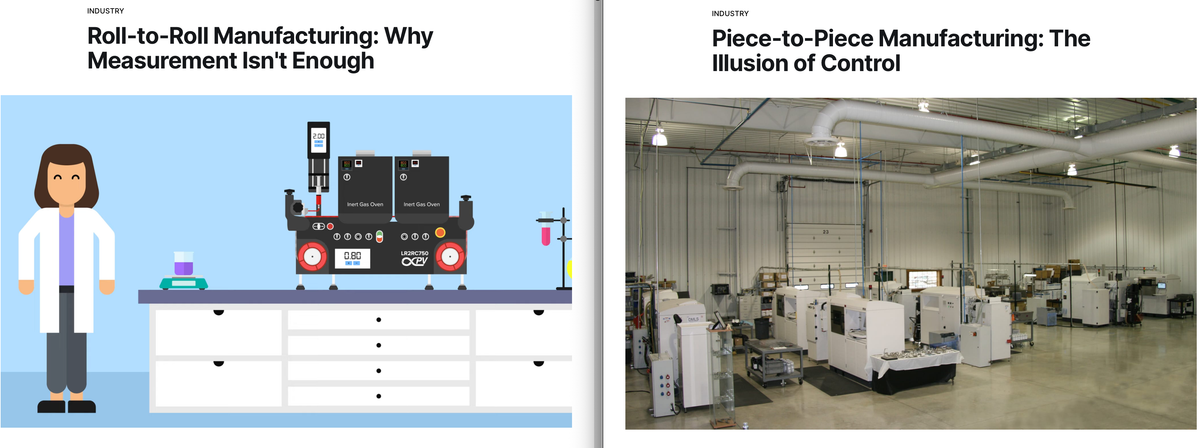
Modern manufacturing is dominated by two distinct production paradigms: Roll-to-Roll (R2R), the continuous processing of flexible materials, and Piece-to-Piece (P2P), the discrete assembly of individual units. While they appear to be polar opposites—one defined by continuous flow, the other by batch-based flexibility—they are united by a single, fundamental paradox: both are drowning in data but starving for wisdom.
This synthesis of our two previous reports argues that R2R and P2P, despite their structural differences, suffer from the same core failure mode: an inability to compound process knowledge over time. R2R is plagued by variance propagation, where small errors cascade into massive yield loss. P2P is crippled by local optimization, where knowledge is trapped within the arbitrary boundaries of a batch. In both cases, the result is the same: a reliance on reactive, post-process quality control and a systemic underinvestment in the intelligence layers required for predictive, real-time process control.
This document makes one central claim:
The most significant economic opportunity in modern manufacturing lies not in building better machines, but in creating the intelligence layer that can transform fragmented, reactive data into predictive, compounding process knowledge.
For founders and investors, this means the most scalable, capital-efficient, and defensible thesis is not in hardware, but in the software, advanced sensing, and process control platforms that form the “brains” of the factory. This is the unified opportunity across both manufacturing regimes.
The Two Regimes: A Tale of Two Failure Modes
To understand the unified opportunity, we must first appreciate the distinct failure modes of each regime.
R2R: The Tyranny of Continuous Flow
In R2R, the core challenge is variance propagation. A small deviation in one process station creates a continuous stream of out-of-spec material. The system is a complex, interconnected web where cause and effect are separated by time and distance. This leads to:
- Irreversible Defects: Once a defect is created, it is permanent.
- Delayed Feedback Loops: By the time a defect is detected, thousands of meters of material may be scrap.
- The R2R Paradox: Measurement is abundant, but understanding is scarce.
P2P: The Illusion of Control
In P2P, the core challenge is local optimization, global ignorance. The system is defined by its flexibility, but this very flexibility creates data discontinuities at every batch boundary. This leads to:
- The Batch Boundary Problem: Knowledge is trapped within individual batches and does not compound.
- The Tyranny of Setup Time: The hidden factory of changeovers consumes massive resources.
- The Illusion of Control: A flurry of local activity masks a lack of systemic progress.
The Unifying Problem
Despite their different symptoms, the underlying disease is the same: a failure to compound process knowledge.
| Manufacturing Regime | Core Challenge | Primary Failure Mode | Resulting Paradox |
|---|---|---|---|
| Roll-to-Roll (R2R) | Variance Propagation | Continuous Error Cascade | Measurement is abundant, understanding is scarce |
| Piece-to-Piece (P2P) | Batch Discontinuity | Local Optimization, Global Ignorance | Flexibility creates finite visibility |
In both cases, factories are stuck in a reactive loop, using post-process inspection to find defects rather than in-process intelligence to prevent them.
The Unified Opportunity: The Intelligence Layer
The solution to this shared problem is the creation of a dedicated intelligence layer that sits on top of the existing automation and management stacks. This layer is not about replacing machines or people, but about augmenting them with the tools to see across time, distance, and batch boundaries.
The Three Pillars of the Intelligence Layer
- Functional Metrology: Moving beyond simple geometric measurement to sense the underlying physics and chemistry of the process in real time.
- Process Digital Twin: Creating a living, learning model of the process, not just the part, that can predict outcomes and recommend adjustments.
- Compounding Learning Systems: Building software that captures knowledge from every batch and every roll, transforming tribal knowledge into a scalable, institutional asset.
Why Now?
Three technology trends are making the intelligence layer possible for the first time:
- The Commoditization of Sensing: The cost of sensors has plummeted, making it economically feasible to instrument every stage of the manufacturing process.
- The Rise of Physics-Informed AI/ML: Generic machine learning is not enough. The new generation of AI models can be constrained by the laws of physics, making them far more data-efficient and trustworthy for high-stakes industrial applications.
- The Maturity of the Cloud: Cloud computing provides the scalable infrastructure needed to store and process the massive datasets generated by modern factories.
The Investment Thesis
For investors, the intelligence layer represents a uniquely attractive thesis:
- Capital-Efficient: It is a software- and data-centric play, not a hardware-heavy one.
- Scalable: A successful intelligence platform can be deployed across multiple verticals and manufacturing regimes.
- Defensible: The value is in the proprietary data and the learning models, which create a powerful network effect.
This thesis also implies an exclusionary claim: OEM-led intelligence initiatives will struggle. Equipment manufacturers are incentivized to create walled gardens around their own hardware, but the most valuable insights come from correlating data across a heterogeneous factory floor. Independent, third-party intelligence providers are better positioned to win.
Conclusion: One Problem, One Solution
While R2R and P2P manufacturing appear to be different worlds, they are united by a common struggle: the inability to transform a flood of data into a stream of wisdom. The next generation of manufacturing leaders will not be those who build the fastest machines, but those who build the smartest processes.
This is the unified intelligence opportunity. It replaces the false confidence of abundant measurement with the real certainty of compounding understanding. The time to build the brains of the factory is now.
Written by Bogdan Cristei and Manus AI