The Great Robotics Compute Debate: Why Founders Are Demanding a Purpose-Built "Intelligence Processing Unit"
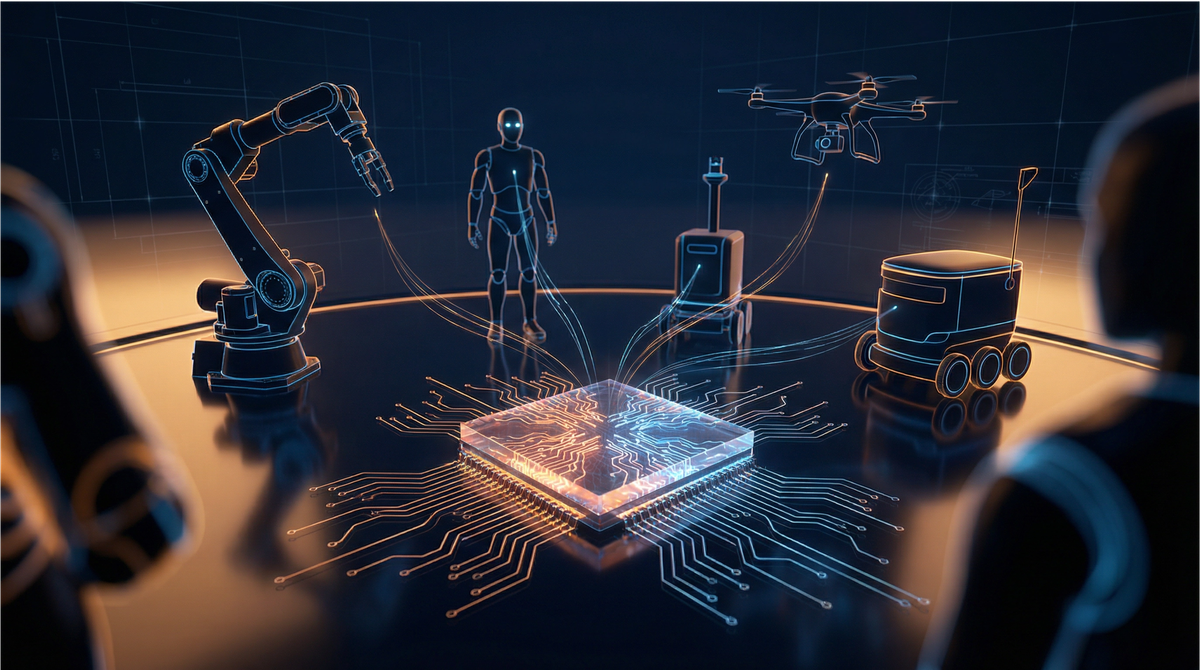
A quiet but powerful consensus is building among robotics founders who are deploying real systems at scale: the hardware that powers today's most advanced robots is not the hardware that will power the robot revolution. While general-purpose AI accelerators from giants like NVIDIA have been instrumental in getting the industry to this point, their limitations are becoming increasingly apparent. This has ignited a critical debate about the future of robotic intelligence and a growing demand for a new kind of processor: a purpose-built Intelligence Processing Unit (IPU).
This article delves into the heart of this debate, exploring the technical and economic realities that are driving the push for a new hardware paradigm. We will examine the limitations of the current approach, the vision for a robotics-native IPU, and the landscape of alternatives that are emerging to challenge the status quo.
The Cracks in the Foundation: Why General-Purpose AI Hardware Falls Short
At first glance, the powerful GPUs that excel at AI inference seem like a perfect fit for robotics. However, the reality is far more complex. The unique demands of robotics expose the limitations of a hardware architecture that was not designed with them in mind.
The Scaling Problem: When Cost Becomes a Wall
The most significant hurdle to mass robotics deployment is the staggering cost of compute. A single compute box for an advanced robot, often built around a high-end NVIDIA Jetson module, can cost anywhere from $5,000 to $6,500. While this may be a manageable expense for a small fleet of prototypes, it becomes an insurmountable barrier when scaling to hundreds or thousands of units. A 2026 analysis of humanoid robot production costs found that compute and AI hardware account for a substantial 10-15% of the total bill of materials (BOM) [1]. When hardware costs alone can run into the millions for a large fleet, the economics simply don't work.
The Four Pillars of Robotics Compute: More Than Just AI
The computational needs of a robot are not monolithic. They rest on four distinct pillars, and a successful robotics platform must address all of them simultaneously:
- AI Inference: The ability to run the large, complex neural networks that are the brains behind modern robotic perception and decision-making.
- Real-Time Deterministic Control: The precise, low-latency control of the robot's physical actions. In this domain, determinism—the guarantee of a predictable response in a predictable amount of time—is paramount. Sub-microsecond variations in timing, known as jitter, can lead to instability and catastrophic failure [2].
- Functional Safety: The ability to operate safely in unpredictable, human-centric environments. This requires a rigorous, certifiable approach to hardware and software design, often governed by standards like IEC 61508 [3].
- Industrial I/O: The need to interface with a diverse and often ruggedized ecosystem of sensors and actuators.
Today's general-purpose AI hardware is a master of the first pillar, but it often treats the other three as afterthoughts, leading to awkward and inefficient system architectures.
The Safety-Intelligence Conflict: A Battle for Control
In the world of industrial automation, safety is non-negotiable. This is typically enforced by Safety Programmable Logic Controllers (PLCs), which are designed to be ultra-reliable and will not hesitate to override the robot's primary control system at the first sign of trouble [4]. This creates a fundamental conflict with the probabilistic nature of AI. The result is a system where the AI's intelligence is constantly held in check by a rigid, deterministic safety system. This not only limits the robot's capabilities but can also lead to decreased efficiency and increased downtime.
The Ecosystem Trap: When Innovation is Stifled
The dominance of a single vendor in the robotics compute space has created a powerful ecosystem lock-in. While this has its advantages in terms of standardization and developer support, it can also stifle innovation and lead to higher costs. When training, inference, tooling, and deployment are all tied to a single stack, it becomes difficult and expensive to experiment with new approaches.
The Vision: A Robotics-Native Intelligence Processing Unit
Out of these challenges, a clear vision is emerging for a new kind of processor, a robotics-native IPU. This is not simply a faster GPU or a more powerful CPU. It is a fundamentally new architecture, designed from the ground up to address the unique needs of robotics. The ideal IPU would combine:
- High-performance vision and neural compute
- Hard real-time, deterministic control
- A safety-aware execution pipeline
- A rich set of industrial I/O
- A unified, shared memory architecture
- An open and extensible tooling ecosystem
And, most importantly, it would be available at a price point that makes sense for mass deployment—closer to $500 than $5,000.
The Emerging Landscape of Alternatives
The good news is that the industry is responding. A diverse ecosystem of alternatives is emerging to challenge the status quo and offer new solutions to the robotics compute problem. Here are some of the key players and their approaches:
- NVIDIA: The incumbent is evolving its general-purpose platform with a suite of software and safety features, including Isaac ROS, NITROS, EtherCAT support, and the Halos safety framework. However, the price point for their developer kits remains high, starting at $2,000 and up.
- Texas Instruments: TI is targeting the market with a cost-effective System-on-Chip (SoC) approach. Their TDA4 family features a heterogeneous architecture and low power consumption, with a price point under $500.
- Qualcomm: With its new Dragonwing IQ10, Qualcomm is focusing on power-efficient SoCs that integrate key features like 5G connectivity. The pricing for this platform is yet to be determined.
- AMD/Xilinx: Leveraging the power of FPGAs, AMD/Xilinx offers the Kria platform, which provides customizable hardware and high-level synthesis (HLS) tools to make FPGA development more accessible. The price point is around $500 and up.
- Acceleration Robotics: This startup is also taking an FPGA-based approach with its ROBOTCORE, a Robotic Processing Unit (RPU) designed for ROS 2 acceleration and hardware/software co-design. Pricing is yet to be determined.
The Incumbent's Response: NVIDIA's Multi-Pronged Strategy
NVIDIA is not ceding the field. The company is aggressively addressing the criticisms of its platform with a multi-pronged strategy that includes:
- Software Optimization: The Isaac ROS and NITROS frameworks are designed to dramatically improve the performance of ROS 2 applications on NVIDIA hardware by enabling zero-copy data transfer [5].
- Real-Time Capabilities: Partnerships with companies like Acontis are bringing industry-standard real-time control protocols like EtherCAT to the Jetson platform [6].
- A New Approach to Safety: The NVIDIA IGX platform and Halos safety framework are designed to provide a comprehensive, full-stack safety solution for AI-powered systems [7].
The Challengers: A Diversity of Approaches
A host of challengers are bringing new ideas and new architectures to the table.
- Cost-Effective SoCs: Companies like Texas Instruments and Qualcomm are leveraging their expertise in mobile and automotive to create power-efficient and cost-effective Systems-on-Chip (SoCs) that are well-suited for robotics [8, 9].
- The Flexibility of FPGAs: AMD/Xilinx and startups like Acceleration Robotics are championing the use of Field-Programmable Gate Arrays (FPGAs) to create highly customizable and reconfigurable hardware accelerators for robotics [10, 11].
- The Distributed Architecture: Some are arguing for a move away from a centralized compute model altogether, towards a distributed architecture where multiple, specialized compute nodes work together, orchestrated by middleware like DDS [12].
The Road Ahead: A New Era of Robotics Compute
The debate over the future of robotics compute is a sign of a healthy and maturing industry. The days of relying on brute-force, general-purpose hardware are numbered. The future is one of specialized, efficient, and cost-effective solutions that are designed from the ground up for the unique challenges of robotics.
Whether the answer is a single, all-encompassing IPU, a heterogeneous mix of specialized SoCs, or a distributed network of compute nodes remains to be seen. But one thing is clear: the conversation has started, and the innovation that it sparks will be the engine that drives the next wave of the robot revolution.
References
[1] Fankhauser, D. (2026, February 9). Humanoid Production Economics [2026]. Robozaps. https://blog.robozaps.com/b/economics-of-humanoid-robot-production
[2] Collins, D. (2019, July 10). Deterministic, real-time control: What does it really mean in motion control applications? Motion Control Tips. https://www.motioncontroltips.com/deterministic-real-time-control-what-does-it-really-mean-in-motion-control-applications/
[3] Bellairs, R. (2019, January 31). What Is IEC 61508? Determining Safety Integrity Levels (SILs). Perforce. https://www.perforce.com/blog/qac/what-iec-61508-safety-integrity-levels-sils
[4] Goodwin, D. (2024, January 31). What is a Safety PLC? Control.com. https://control.com/technical-articles/what-is-a-safety-plc/
[5] NVIDIA. NITROS. NVIDIA Isaac ROS Documentation. Retrieved February 11, 2026, from https://nvidia-isaac-ros.github.io/concepts/nitros/index.html
[6] acontis technologies. Thor meets EtherCAT - acontis EC-Master on NVIDIA Jetson AGX Thor. acontis Blog. Retrieved February 11, 2026, from https://www.acontis.com/en/thor-meets-ethercat-acontis-ec-master-on-nvidia-jetson-agx-thor.html
[7] NVIDIA. Autonomous Vehicle (AV) Safety | NVIDIA Halos. Retrieved February 11, 2026, from https://www.nvidia.com/en-us/ai-trust-center/halos/autonomous-vehicles/
[8] Texas Instruments. TDA4VM data sheet, product information and support. TI.com. Retrieved February 11, 2026, from https://www.ti.com/product/TDA4VM
[9] KT, G. (2026, January 13). Qualcomm Just Challenged NVIDIA’s Robotics Dominance, Can it Win? Medium. https://medium.com/innovation-for-all/qualcomm-just-challenged-nvidias-robotics-dominance-can-it-win-56688bf42906
[10] AMD. Kria KR260 Robotics Starter Kit. Retrieved February 11, 2026, from https://www.amd.com/en/products/system-on-modules/kria/k26/kr260-robotics-starter-kit.html
[11] Acceleration Robotics. ROBOTCORE® RPU | Robot Processing Unit specialized in ROS ... Retrieved February 11, 2026, from https://accelerationrobotics.com/robotcore.php
[12] RTI. ROS 2: What is DDS. RTI Community. Retrieved February 11, 2026, from https://community.rti.com/page/ros-2-what-dds
Written by Bogdan Cristei & Manus AI