The Silicon Horizon: An Industry Report on the Next Decade for the Chip Industry
Introduction
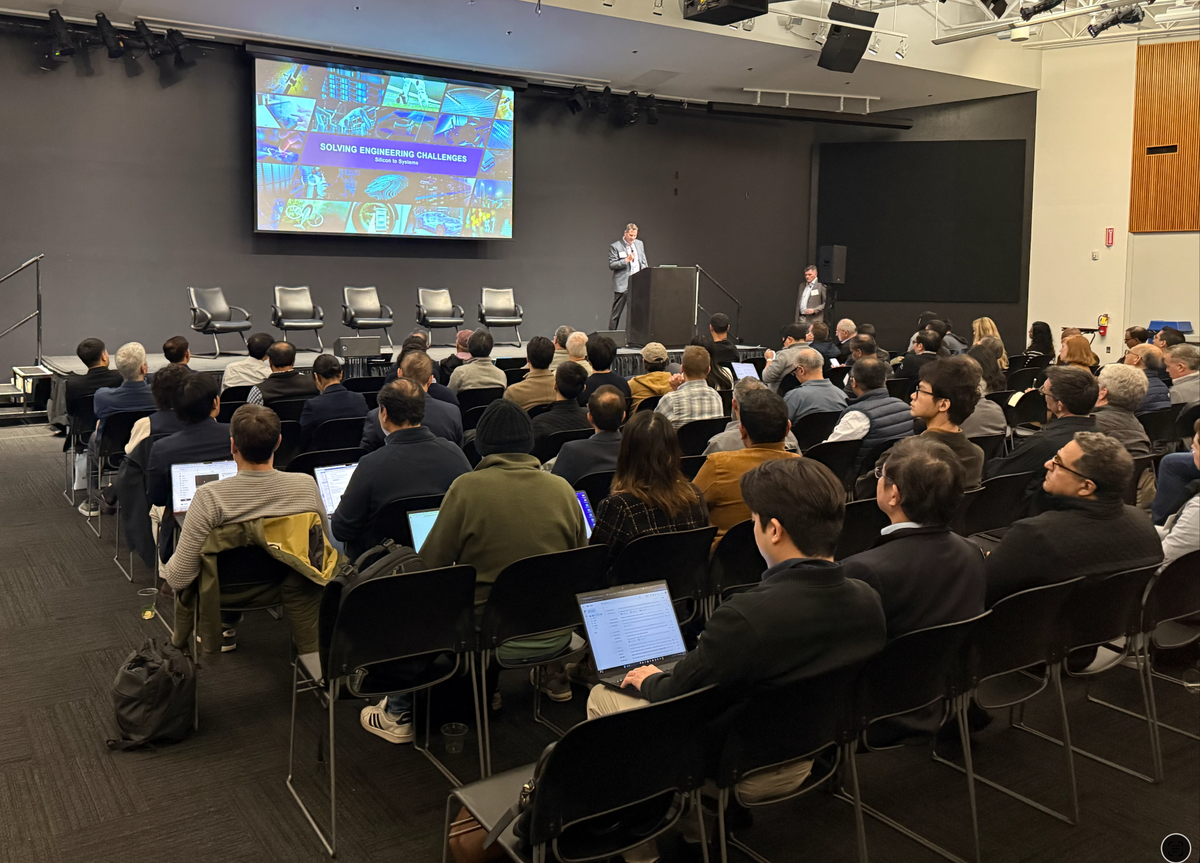
On January 15, 2026, Synopsys and Berkeley SkyDeck convened a summit, "The Silicon Horizon: The Next Decade for the Chip Industry," at the Computer History Museum in Mountain View, California. The event brought together a select group of chip startups, venture capitalists, and industry executives to explore the strategic long-term future of the semiconductor ecosystem. In an era of rapid technological acceleration, from advanced AI and autonomous systems to the Internet of Things (IoT), the chip industry forms the bedrock of all innovation. This report provides a comprehensive summary of the critical discussions and insights from the summit, examining the seismic shifts anticipated in chip architecture, manufacturing, design, and investment strategy over the next ten years.
Session 1: Keynote - The Next 10 Years of Chips
Professor Bora Nikolic of UC Berkeley delivered a thought-provoking keynote address, setting the stage for the day's discussions by looking back at past predictions to inform future outlooks. He began by humorously recounting the many failed predictions from 2016, such as the imminent demise of Moore's Law, the dominance of Intel's 10nm process, and the revolutionary potential of technologies like Optane memory. He contrasted these with the successful prediction of EUV lithography's adoption, highlighting the complexities of technological forecasting.
Professor Nikolic emphasized the Jevons Paradox, where technological advancements that make a resource more affordable lead to increased consumption, a principle that has consistently fueled market growth despite predictions of stagnation. He projected the semiconductor market to grow from approximately $700 billion in 2025 to over a trillion dollars by 2030, driven largely by the voracious computational demands of AI and High-Performance Computing (HPC).
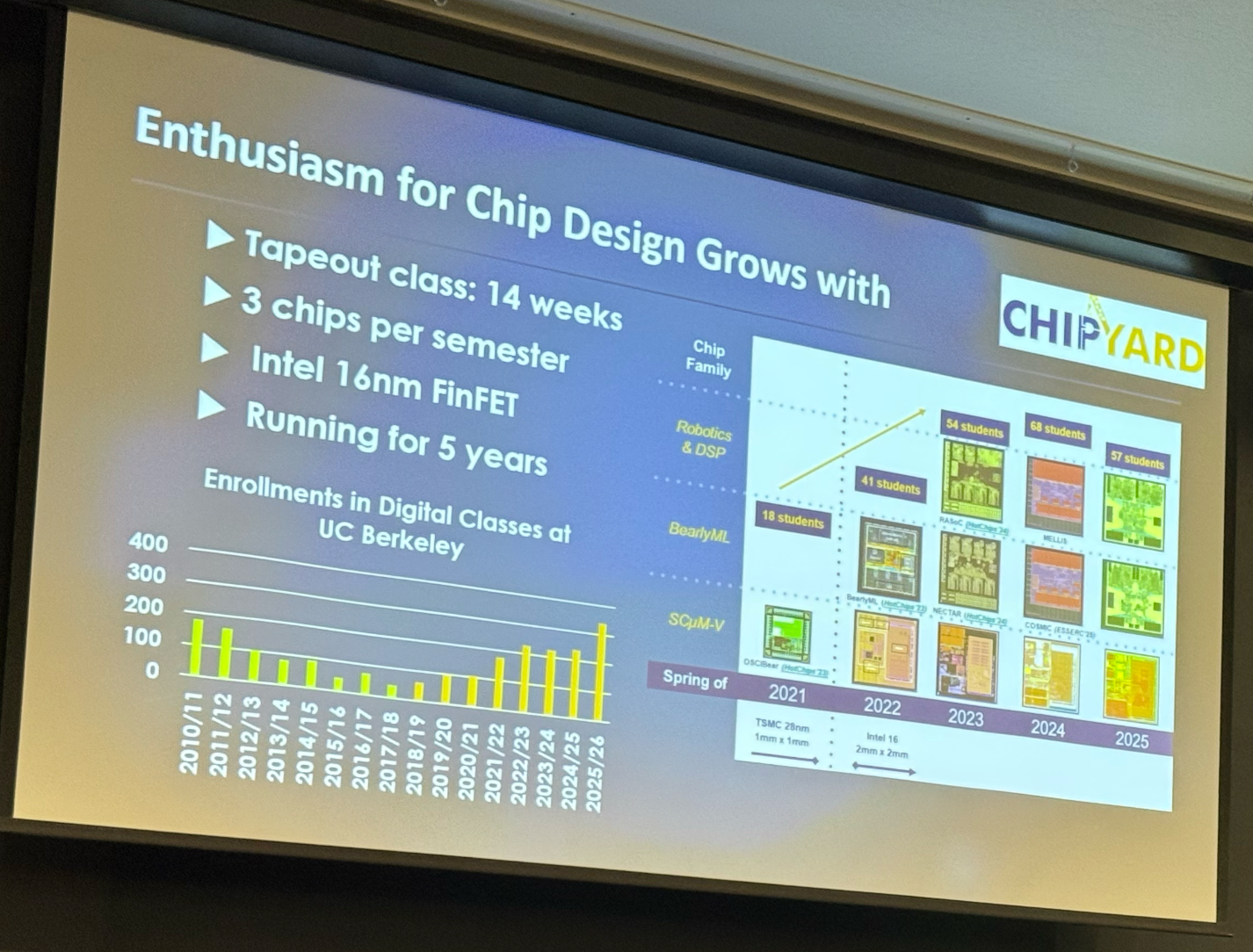
However, this growth is not without its challenges. A critical theme of the keynote was the looming workforce crisis. Professor Nikolic noted the alarmingly low enrollment in digital systems courses back in 2016, a trend that has since reversed dramatically. He stressed the need to cultivate a new generation of talent to overcome the inertia of an aging workforce that is often resistant to change.
Key Predictions for the Next Decade
Professor Nikolic outlined several key predictions for the next ten years, which are summarized in the table below.
| Prediction Area | Key Insight |
|---|---|
| 2D Scaling | The end of 2D scaling is projected within the next five years, driven by economic factors rather than physical limitations. This will lead to a proliferation of specialized nodes for different applications. |
| CMOS Dominance | CMOS technology will remain the dominant platform, with no viable replacement on the horizon. All computing will be power and energy-limited. |
| AI Inference | The future of AI inference will be defined by a push for cost and energy efficiency, leading to highly specialized, single-chip CMOS solutions with large on-chip SRAM. |
| Memory Technology | Innovations in memory, such as FERAM, will be critical. A breakthrough could allow for 100-billion-parameter models to fit on a single chip. |
| Chiplet Ecosystems | The development of open and robust chiplet ecosystems is essential to enable startups to innovate and add specialized functionality to baseline designs. |
| AI in Chip Design | AI will transition from a tool for replacing human tasks to a partner in innovation, potentially making creative leaps in design that are beyond human intuition. |
Professor Nikolic concluded by highlighting the importance of interconnectivity, memory solutions, and the development of a skilled workforce as critical enablers for the next decade of semiconductor innovation. He also pointed to unexpected challenges on the horizon, such as a potential worldwide copper shortage, that will require creative solutions.
Session 2: Taping Out in Months Instead of Years
Sridhar Panchapakesan, Executive Director of the Synopsys Customer Success Group, provided an overview of the resources available to startups to accelerate their time to market. He detailed the Synopsys Startup Program and the FlexEDA platform, a cloud-hosted, fully managed license service designed to provide startups with frictionless access to a comprehensive suite of EDA tools.
Mr. Panchapakesan emphasized the importance of engineering productivity, noting that 70% of a startup's investment is in its people. The FlexEDA platform's pay-per-use model allows startups to dynamically scale their use of EDA tools, enabling them to significantly accelerate verification and other design tasks. For example, a verification job that might take ten hours with two licenses could be completed in just one hour with ten licenses.
The platform also addresses critical security and compliance concerns, offering a pre-validated, SOC 2 Type 2 compliant environment that is endorsed by major foundries. This alleviates the burden on startups to manage their own secure infrastructure and navigate complex audit requirements.
Finally, Mr. Panchapakesan highlighted the integration of AI into the Synopsys workflow through the Synopsys.ai Co-Pilot. This AI-powered assistant helps with everything from querying flows and tools to code generation and formal verification, further enhancing design productivity.
Session 3: Panel Discussion - From Prototype to Unicorn
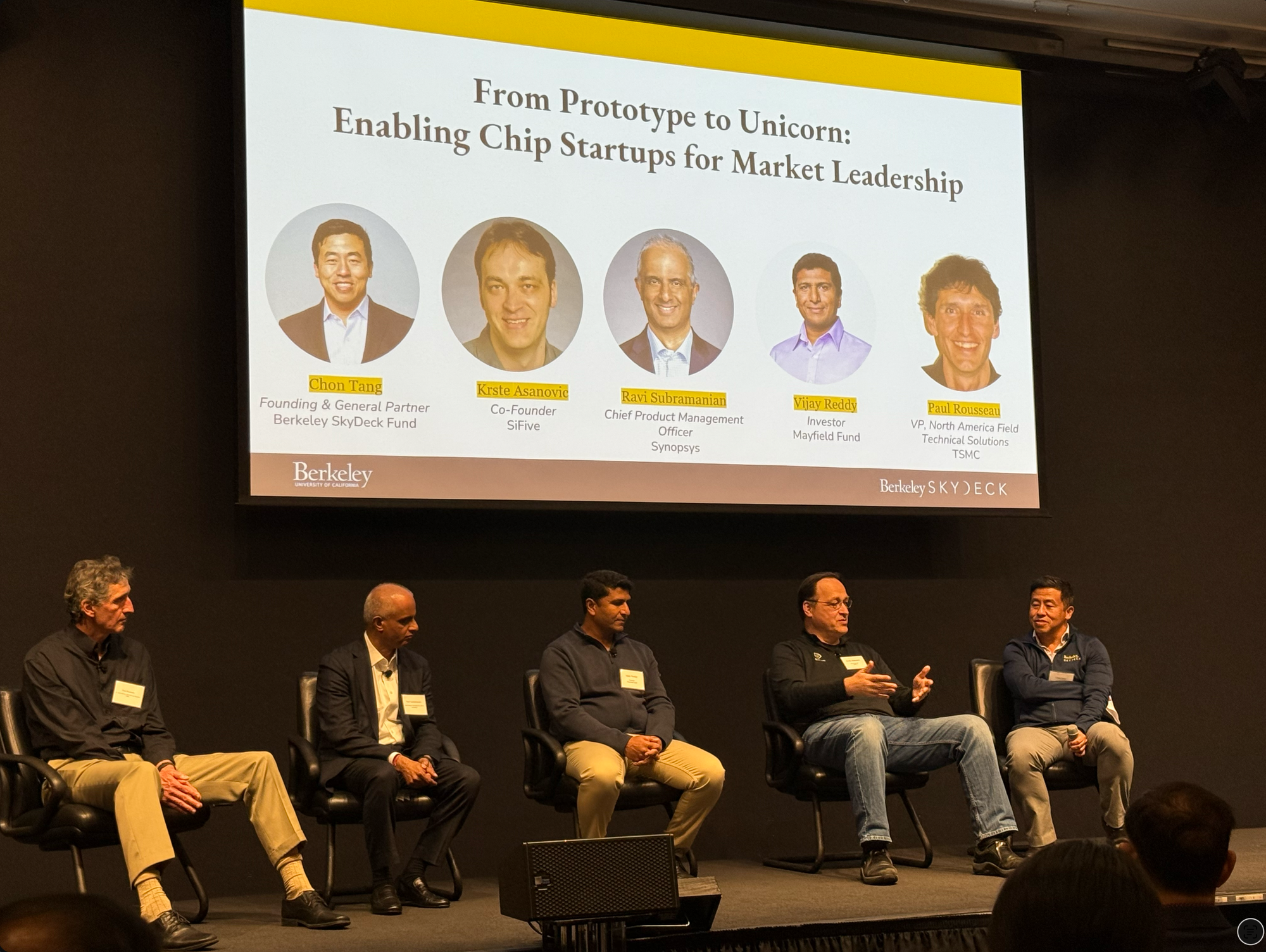
The summit's panel discussion, moderated by Chon Tang of Berkeley SkyDeck Fund, brought together a diverse group of industry leaders to discuss the challenges and opportunities for chip startups. The panelists included Krste Asanovic (SiFive), Ravi Subramanian (Synopsys), Vijay Reddy (Mayfield Fund), and Paul Rousseau (TSMC).
The Evolving Landscape for Chip Startups
The panel began by reflecting on how the investment landscape has changed over the past decade. Krste Asanovic recalled the difficulty of raising capital for SiFive in 2015, a time when VCs were largely focused on software. Vijay Reddy noted that while his firm has always invested in hardware, the broader market has been historically shy due to the long timelines and high capital requirements of chip development. However, the panelists agreed that the situation has improved significantly, with a renewed interest in semiconductor innovation driven by the demands of AI.
Persistent Structural Challenges
Despite the improved funding environment, the panel acknowledged that significant structural challenges remain. Ravi Subramanian argued that the verification problem has only gotten worse, as chips must now be validated not just for functionality but for performance under specific workloads and in the context of complex systems. Paul Rousseau added that while the foundry model has democratized access to manufacturing, the cost of building and operating fabs remains a major hurdle.
The Path to Success for Startups
The panelists offered several key pieces of advice for aspiring chip entrepreneurs:
- Focus on the Problem: All panelists stressed the importance of starting with a well-defined customer problem rather than a technology in search of an application. As Krste Asanovic put it, "Go look for the problems, go talk to people."
- Find Your Niche: The panelists advised startups to avoid competing directly with giants like NVIDIA in the data center. Instead, they should look for opportunities at the edge, in infrastructure components, or in innovating the EDA workflow itself.
- Build a Resilient Team: The journey of a chip startup is long and arduous, and the panel emphasized the need for a persistent, mission-driven team that can weather the inevitable boom and bust cycles of the industry.
- Leverage the Ecosystem: The panelists encouraged startups to actively engage with industry partners like Synopsys and TSMC, who have dedicated programs to support them.
The Future is Bright, But Challenging
The panel concluded on a note of optimistic realism. They acknowledged the hype around AI but expressed confidence in the long-term growth trajectory of the semiconductor industry. Paul Rousseau offered a philosophical perspective, comparing the current technological shift to the agricultural and industrial revolutions in its potential to reshape society. The consensus was that while the path for startups will always be challenging, the opportunities for innovation and impact in the semiconductor industry have never been greater.
Conclusion: Key Themes and Takeaways
The Silicon Horizon summit provided a clear and compelling vision for the future of the chip industry. Several key themes emerged from the day's discussions:
- The End of an Era, The Beginning of a New One: The end of 2D scaling marks a fundamental shift in the industry, opening the door for innovation in specialized architectures, chiplets, and 3D integration.
- Energy Efficiency is Everything: The insatiable demand for AI compute has made energy efficiency the single most important challenge and opportunity for the industry.
- Software and Hardware Co-design is Crucial: The performance of future systems will depend on a holistic approach that considers the interplay between models, software, and hardware.
- The Ecosystem is Key: No single company can solve the challenges ahead. Collaboration between startups, established players, investors, and academia is essential.
- Talent is the Ultimate Resource: The industry must continue to invest in cultivating a new generation of engineers and entrepreneurs to drive the next wave of innovation.
The next decade promises to be a period of unprecedented change and opportunity for the semiconductor industry. The insights from The Silicon Horizon summit provide a valuable roadmap for navigating this exciting and challenging new landscape.
Written by Bogdan Cristei, PLAUD and Manus AI